ASHEVILLE, N.C. (828newsNOW) — Families across North Carolina are waiting longer for death certificates, cremations and answers after the deaths of loved ones as a growing shortage of medical examiners strains the state’s death investigation system.
Medical examiners across Western North Carolina say years of stagnant pay, rising caseloads and staffing shortages have pushed the system to a breaking point, leaving some counties without consistent coverage and forcing examiners to travel across multiple counties to handle cases.
Buncombe County medical examiner Paula Case said the effects are increasingly being felt by families already navigating grief.
“The way a death is certified matters,” Case said. “It affects everything for that family.”
In an email sent on behalf of nearly 100 medical examiners, Case described what she called a “crisis in plain sight” inside the North Carolina Office of the Chief Medical Examiner, arguing that legislative inaction is worsening staffing shortages and delays.
Pay frozen for a decade
At the center of the dispute is compensation. Case said North Carolina medical examiners are paid $200 per case, a rate she said has not increased since 2015.
“We pay for our own supplies — gloves, needles, syringes, PPE,” she said. “We use our own vehicles and pay for gas mileage.”
According to Case, only toxicology kits are provided by the state, leaving many routine field expenses to be covered out of pocket.
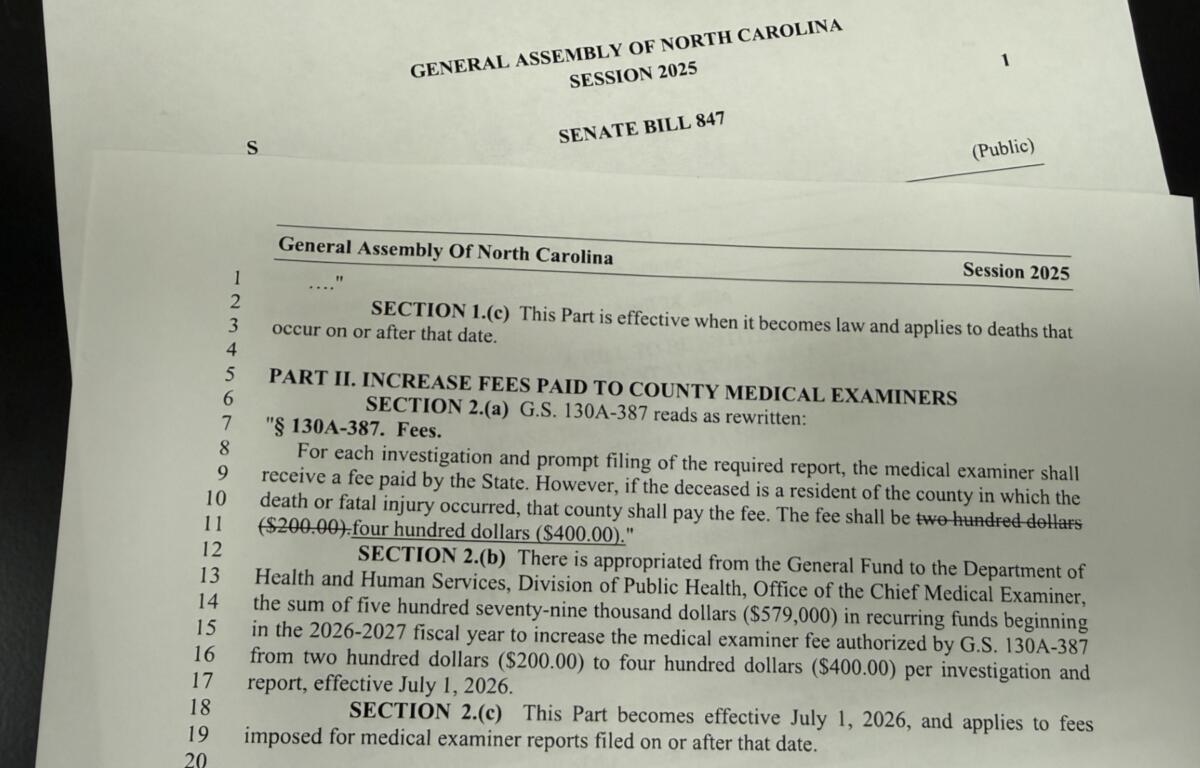
Medical examiners are seeking an increase to $400 per case to better reflect inflation and increased workloads. Case said proposals to raise pay have repeatedly stalled or been removed from legislative drafts since 2023.
A more recent effort tied to Senate Bill 847, known as “Tyler’s Law,” also stalled in the legislature. The bill would increase compensation for medical examiners while also expanding investigative requirements in apparent suicide cases.
Under the proposal, medical examiners would be required to complete additional investigative steps before officially ruling a death a suicide, including interviews and, in some cases, forensic testing.
The bill was referred to the Senate Appropriations Committee in April and has not advanced further.
“It was added and removed very quickly,” Case said. “And then it just stalled. It’s just not going anywhere.”
Growing caseloads, shrinking coverage
The staffing shortage has forced many examiners to cover large geographic areas.
Buncombe County, which has five medical examiners, handled about 450 cases last year, with 215 cases reported so far this year as of late May, Case said.
She said she regularly covers Buncombe, Madison, Mitchell, Yancey, Haywood, Henderson and Transylvania counties.
“Sometimes I’m driving an hour just to reach a case,” she said.
Case said roughly 250 medical examiners are actively working statewide despite more than 350 allocated positions. She pointed to Avery County, which she said currently has no medical examiner, as an example of the growing coverage gaps in rural areas.
“We’ve lost a lot of medical examiners in the past six months,” she said. “A lot of that is frustration.”
Burnout and administrative pressure
Case said additional administrative demands are also driving people away from the work.
She described increased training requirements and digital reporting systems that add hours of unpaid work outside of investigations.
“It’s computer training, documentation — all of that is on our own time,” she said. “If you don’t have it done, you can’t continue as a medical examiner.”
Complex investigations involving homicides, pediatric deaths or unidentified remains can take hours or days to complete, she said, even while examiners are expected to meet reporting deadlines.
“Those cases may take hours to days,” she said. “And then you still have the same deadline.”
Case said the added investigative requirements proposed in Senate Bill 847 could further increase workloads unless staffing and compensation issues are addressed at the same time.
Concerns about statewide disruptions
Case also raised concerns about possible service disruptions if staffing concerns remain unresolved. She said some medical examiners have discussed taking coordinated time off beginning June 15.
She said that could temporarily leave some counties without coverage, delaying death certificates, cremations and the transport of remains home to families.
“There are too many of us to just disappear,” she said. “But people are frustrated.”
State acknowledges staffing shortages
In a statement to 828newsNOW, the North Carolina Department of Health and Human Services acknowledged recruitment and retention problems within the state’s medical examiner system.
“Local Medical Examiners are critical parts of the Medical Examiner System,” NCDHHS spokesperson Summer Tonizzo said. “Delays in this work make a significant difference to families dealing with the death of a loved one, as well as to our health and criminal justice systems.”
The department said the number of appointed medical examiners has fallen to 275 statewide, the lowest level in more than a decade and a decline of more than 45 percent since 2023.
NCDHHS said the Governor’s Office and the department support additional investments in the system and pointed to past legislative funding increases for forensic pathologists, toxicology staffing, autopsy services and expanded eligibility requirements for medical examiners.
Still, Case said frontline medical examiners continue to feel overlooked because they are neither direct county nor state employees, but instead work through state-funded fee structures.
“We fall through the cracks,” she said. “We’re not really part of a single system that advocates for us.”
Efforts to reach Gov. Josh Stein’s office, Attorney General Jeff Jackson and local lawmakers for comment were unsuccessful.
‘The last time I can help that family’
For Case, the work remains deeply personal.
“This is the last step of nursing for me,” she said. “It’s the last time I can help that family.”