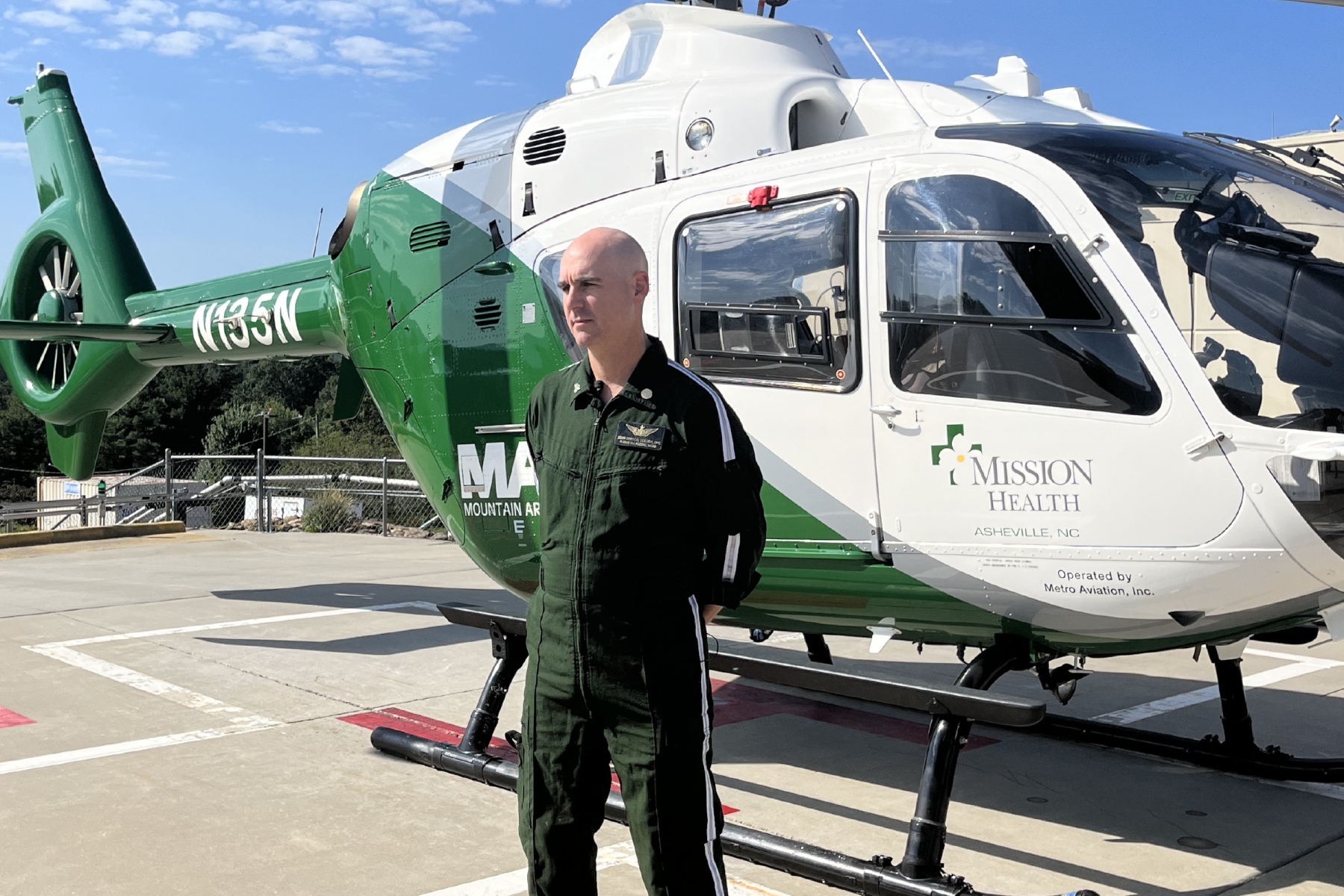
ASHEVILLE, N.C. (828newsNOW) — John Carrico still remembers his first flight with Mountain Area Medical Airlift.
It was a car wreck in Transylvania County, where Carrico lives.
Twelve years later, he has flown on roughly 1,100 patient flights and has seen just about every kind of emergency Western North Carolina can throw at a medical helicopter crew.
But that first flight has stayed with him.
“I was flying in a helicopter down to my community,” Carrico said. “And being able to take care of somebody … it felt like a big deal to me.”
This month, Mountain Area Medical Airlift — better known as MAMA — is marking 40 years of service in WNC.
Since 1986, MAMA crews have flown more than 31,000 patients, bringing critical care to people across a region where steep mountains, winding roads and remote communities can make getting to a hospital a race against time.
For Carrico, the numbers are impressive. But they’re not what keeps him coming back.
“I think I speak on behalf of not just myself, but most of the team,” he said. “None of us ever wished for anything to happen to anybody in Western North Carolina or anywhere, for that matter.
“But when it does happen, we want to be the people who are there taking care of them.”
Waiting for the next call
Carrico has been a paramedic for years, first working on an ambulance before joining MAMA.
His job now is as a flight paramedic, but the work doesn’t begin when the helicopter lifts off.
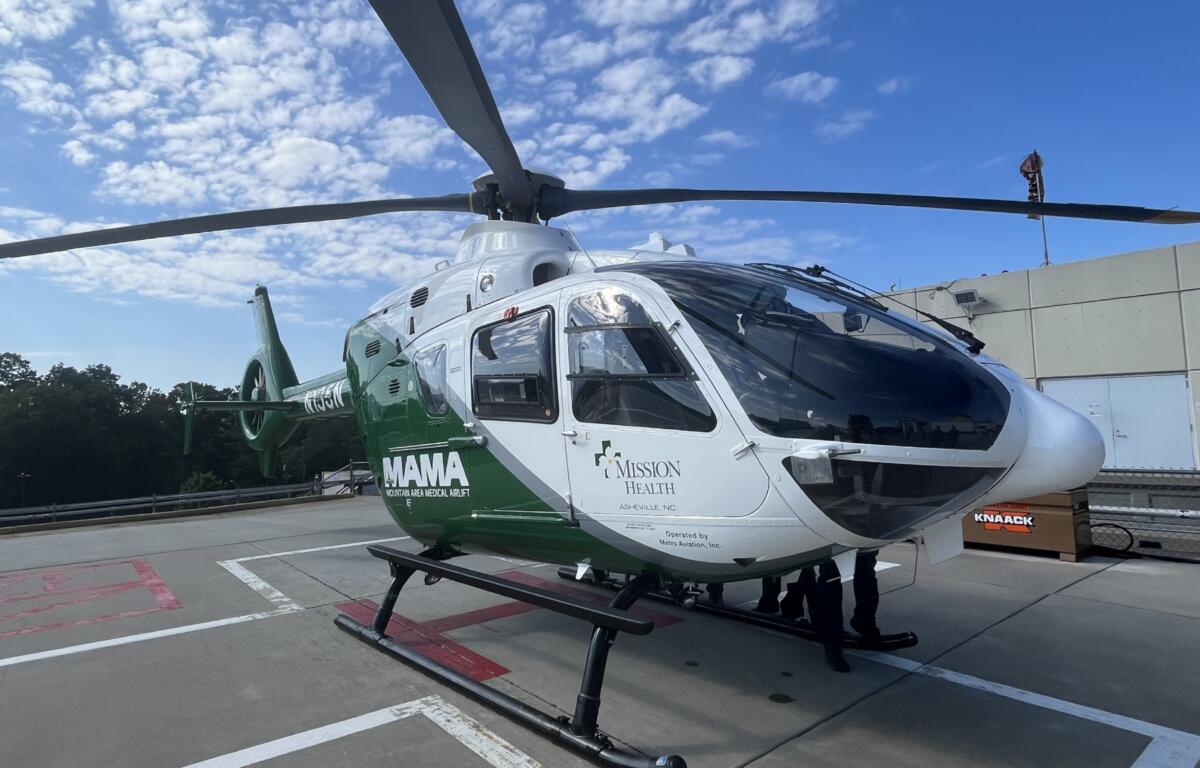
MAMA has two bases — one at Mission Hospital in Asheville and another in Franklin at Angel Medical Center. Depending on their schedules, crews work 12- or 24-hour shifts.
They check equipment. They restock supplies. They train. They eat when they can.
And they wait.
The quiet can end quickly.
Carrico said MAMA crews generally aim to be airborne within about eight to 10 minutes of being dispatched.
A typical flight can take about two hours by the time the crew reaches the patient, assesses and stabilizes them, flies them to a hospital, then cleans and restocks the helicopter.
On average, the helicopters make two to three flights during a 24-hour period.
In between those calls, crews keep training and preparing for the next one.
“You never know exactly when you’re going to be able to get your meal in,” Carrico said.
The unpredictability is part of the job.
So is knowing that when the helicopter is dispatched, somebody is having a very bad day.
And that’s the part Carrico said never becomes routine.
‘You don’t get desensitized to the people’
Seeing people on some of the worst days of their lives can be difficult, Carrico said.
The crews learn to function in those situations. They have to.
But that doesn’t mean they stop feeling them.
“You do get desensitized in terms of what you see,” Carrico said. “But you don’t get desensitized to the people.”
That’s why mental health and well-being have become an important part of the work for MAMA crews and other first responders.
The things they see aren’t normal parts of everyday life, Carrico said, and crews need outlets and support away from the job to continue doing it for years.
Sometimes, though, the difficult calls lead to moments that stay with crews for entirely different reasons.
Carrico remembers meeting patients and family members after the flight — including a mother who came up to him and hugged him because he had flown her child.
“I’m not a person who gets choked up very often,” he said. “But when a mother comes up to me and hugs me because I flew their child … what a very intimate moment to experience.”
Those encounters can be rewarding, he said, even when the outcome isn’t what everyone hoped for.
“Not all our patients have outcomes that are full of rainbows,” Carrico said.
Some patients live with lifelong problems. Some don’t survive.
But sometimes families still come back to thank the people who cared for their loved one.
“Sometimes we’re providing a little bit more time for them to be with them,” Carrico said. “Or they know that at least in their final hours that they were well taken care of by a compassionate group of people.”
Those moments matter.
“They just kind of give us that extra energy to continue doing our job,” he said.
More than flying
Carrico’s job doesn’t end when he gets off the helicopter.
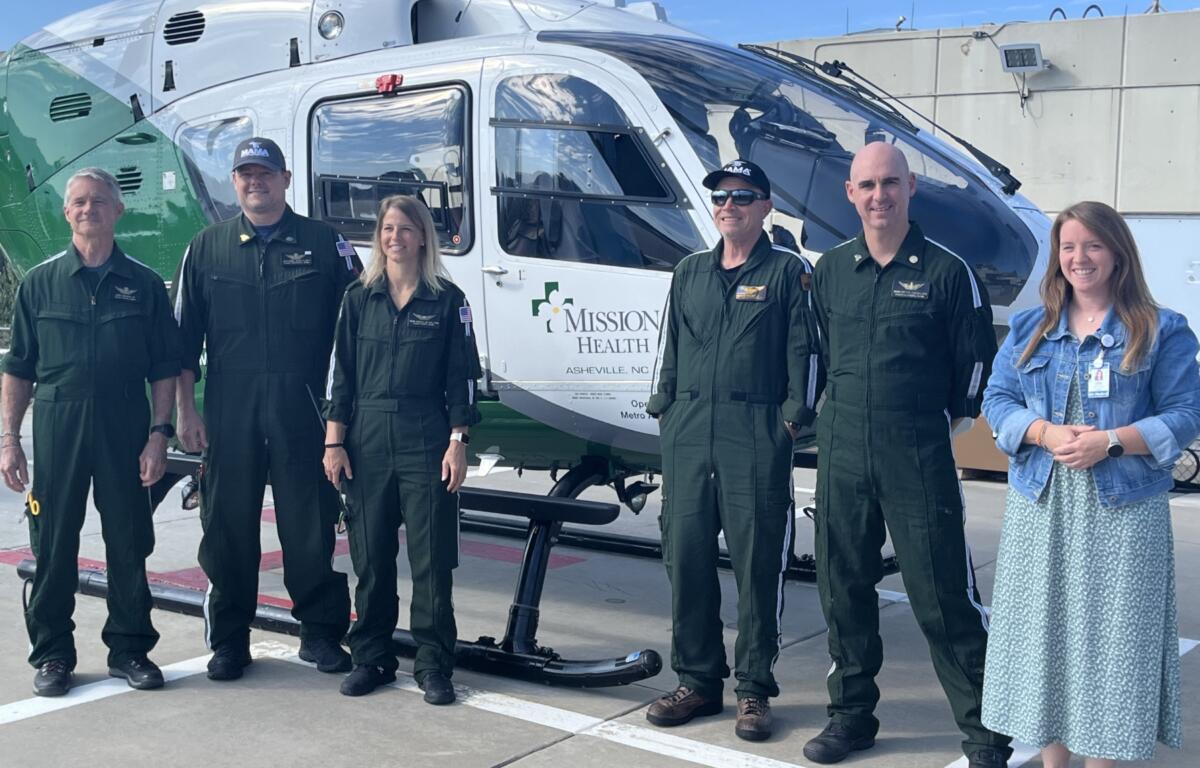
One of his other responsibilities is MAMA’s outreach and education program. He works with EMS agencies, fire departments and hospitals throughout WNC.
It’s a part of the job the public may not see.
“We do a lot of education and training not only for ourselves … but with all the other agencies and hospitals around Western North Carolina,” he said.
MAMA crews care for some of the sickest patients in the region, and Carrico said that makes other first responders and medical professionals look to them for specialized knowledge.
The goal is to make sure everyone is better prepared when the next emergency happens.
“The better that we’re all prepared together, the better the outcomes are for our patients,” he said.
A different kind of sky after Helene
Then came Tropical Storm Helene.
Like virtually every other emergency service in the mountains, MAMA was heavily affected by the disaster.
But Carrico remembers one particular challenge: the sky.
MAMA crews are accustomed to being one of the few medical helicopters operating in Western North Carolina.
After Helene, there were helicopters everywhere.
“Some days there could have been 50 helicopters in Western North Carolina,” Carrico said.
For a medical flight crew, that created a new level of risk.
“We do everything we can to mitigate risk,” he said. “But that was a real, real sobering experience.”
The storm also changed the geography of emergency response.
Roads that had once provided relatively easy access to communities were damaged or gone. Places that weren’t considered especially remote suddenly were.
Carrico pointed to Lake Lure and parts of Yancey, Mitchell and McDowell counties.
As roads reopened, some of those challenges eased. But the experience showed how quickly the region’s transportation network can change — and how important a helicopter can become when the roads can’t get people where they need to go.
What comes next?
Carrico has been doing this long enough to remember when today’s technology seemed like science fiction.
So what will MAMA look like another 20 or 30 years from now?
He isn’t sure.
Maybe electric helicopters. Maybe aircraft that can be operated remotely. Maybe technology that today sounds more like science fiction than medicine.
But he’s confident about one thing: The crews will be able to do more for patients.
“Medicine continues to get better,” Carrico said. “The technology and the equipment that we carry allows us to do even more farther away from a hospital.”
Today, MAMA essentially operates as a flying intensive care unit, allowing crews to provide hospital-level care before a patient ever reaches the hospital.
In another 15 or 20 years, Carrico expects that capability to be even greater.
And after more than 1,000 patient flights, he’s still motivated by the same thing that drew him to the helicopter in the first place.
“When we’re able to get to the patient and move them quickly and get them to the hospital where the teams can then take over, and those patients have good outcomes, when they walk out of the hospital, there really isn’t anything more satisfying than that,” he said.
“It’s just such an honor to do that.”
For Carrico, that’s what 40 years of MAMA ultimately represents — not the number of flights or the technology in the helicopter, but the people waiting on the ground.
“At the end of the day, we know that we made an impact on people’s lives,” he said.
“And that’s just — it never gets old. It really never gets old.”